
In two months The Who's debut album, My Generation, will celebrate its 60th anniversary. The groundbreaking record that featured the classic "The Kids Are Alright" might be best known for the stuttering title track with the infamous line, "I hope I die before I get old."
When interviewed in 1989 on Good Morning America, lyricist and guitarist Pete Townshend was asked what "old" meant and he responded with an answer that seems to have gotten lost over time.
"'Old' to me then was really 'rich,'" he explained, dressed in a suit and tie. "Somebody that had achieved everything and looked at anybody on the ladder up with an eye to kick them off. So, I guess we're old now."
That confession, sarcastic or not, came 36 years ago as the band was preparing to head out on tour to celebrate their 25th anniversary.
As their crew tears down their stage for the last time in North America in Thousand Palms, CA, for their Farewell Tour, here's a look back at some of the highlights in The Who's history, one that we are extremely grateful that didn't end once Pete and singer Roger Daltrey achieved everything and were high atop that ladder.
When The Who announced they would be bidding adieu to North America, Setlist sent Lindsay Varney, among others, to Florida to witness the opening show of the 17-date run.
"This tour is running with a setlist of gold," Varney wrote. "The 23 songs included every hit any Who fan would demand, along with a couple of deep cuts. Not to mention a live debut fifty-four years after the song’s release in [Pete's brother] Simon Townshend’s standout rendition of 'Going Mobile.'”
As she mentioned in her piece, The Who dusted off the single, "The Song Is Over" from their 1971 album Who's Next, to play near the end of the sets for this tour.
Despite being a great tune, The Who had never performed it live until this year. Townshend had only played it in solo gigs three times, all in 2000. Daltrey only sang it twice solo, in back-to-back Carnegie Hall shows in '94.
The other tour during this decade: The Who Hits Back! Tour (2022–2023)
Albums released during this time: The Who With Orchestra: Live at Wembley (2023 live album)
In the 2010s, the band took part in on some large-scale anniversary world tours. Their 50th anniversary trek ran on for two years beginning at an F1 race in Abu Dhabi, and ending in LA for a UCLA Autism fundraiser that included special guests Eddie Vedder and Joan Jett.
Their studio album, simply titled Who, humorously, was released in December 2019, and became their highest-charting US album since 1978, debuting at #2 on the Billboard 200. That's who!
Albums released during this time: Quadrophenia: The Studio Album box set (2011 reissue), The Who Hits 50! (2014 compilation),Who (2019)
In the wake of the passing of bassist John Entwistle in 2002, the band was forced to adjust to being even more centered around just Pete and Roger. The pair pressed on with their first new studio album in 24 years, Endless Wire (2006).
That record injected new material into the sets and inspired the band to play 112 shows to support the album.
The group also performed at major global events, including the 2001 Concert for New York City, which honored first responders after the September 11 attacks.
Albums released during this time: BBC Sessions (2000 compilation), Blues to the Bush (1999 live album), The Ultimate Collection (2002 compilation), Then and Now (2004 compilation), Endless Wire (2006).
The Who kicked off the '90s by being inducted into the Rock Hall of Fame in 1990. U2 did the honors of welcoming them into the Hall. In his speech, Bono said that more than anyone else “The Who are our role models. I love them and I hate them for that,” adding that they took on more than any other group and succeeded at a lot of it.
But it was early in his speech that he put his finger on what may have been the secret ingredient of the quartet.
"It's written in rock and roll that all you need is love," Bono said, "but as a lot of you out there know, you also need a PA, a light rig, a good manager, a good agent, some good songs. Much more than that, though, you need a great nose.
"It’s essential equipment if you want to be in a great rock and roll band. The Beatles had Ringo. The Faces had two, so they gave Ron Wood to the Rolling Stones, who didn’t have any. I didn’t know until tonight that Ray Davies has such a great one. Even Art Garfunkel, man, that’s amazing. The nose.
"Some people have them, and they chop them off. We call those people pop stars. The Who are rock and roll stars," he said to applause.
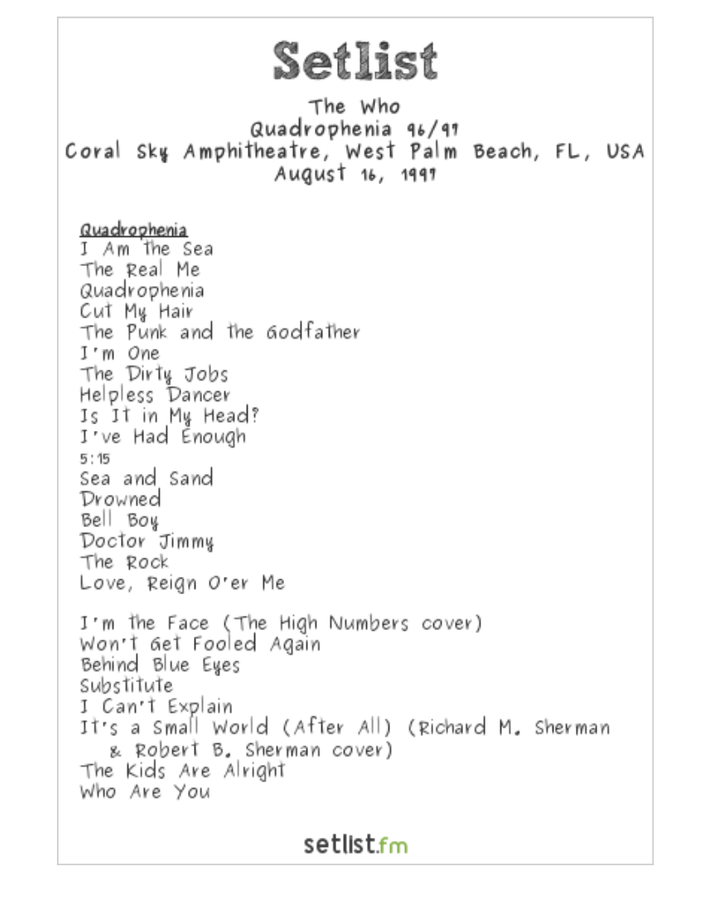
From 1996-97 the band staged a full-on revival of Quadrophenia, the 1973 epic that was the third rock opera the group had released, completely written by Townshend who was just 28 when the double album dropped.
Now decades later, the band performed the album in its entirety with a large supporting cast of guest musicians. While other classic rock groups withered in the wake of Grunge, The Who toured Quadrophenia to remind them what that energy could be turned into once it mixed with genius.
Albums released during this time: My Generation: The Very Best of The Who (1996 compilation), Quadrophenia (revival performances)
It was in the early '80s that The Who announced their first official “farewell” on the heels of two perfectly fine new albums. The year was 1982 and after delivering the dynamic singles “You Better You Bet,” “Don’t Let Go the Coat,” “Another Tricky Day,” “Athena,” “Eminence Front,” and “It’s Hard,” they concluded that was enough.
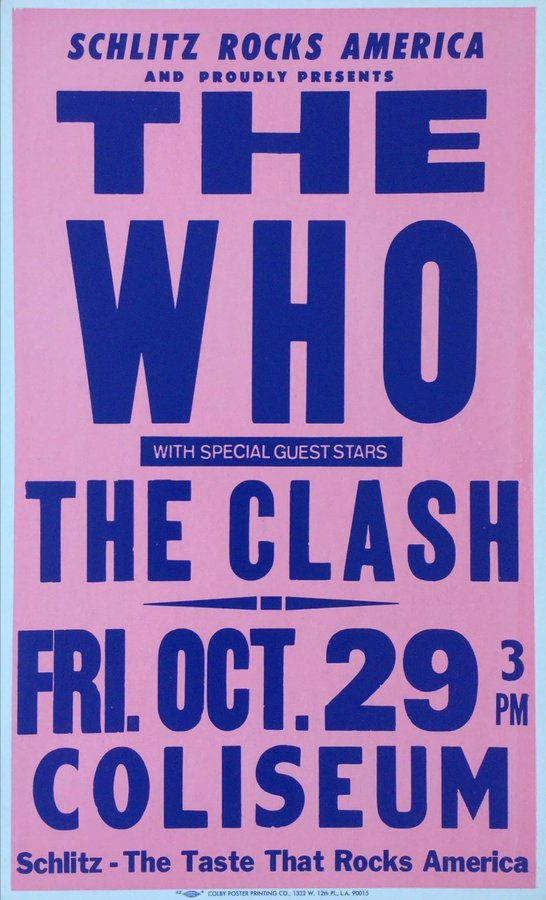
They packed huge arenas and sports complexes. They even had The Clash open for them which many thought was a passing of the torch. Sadly The Clash's days were numbered and wouldn't even make it out of the '80s together, while The Who would roll on for four more decades.
Despite battling hearing issues, Townshend pursued solo projects while Daltrey accepted acting roles in film and TV.
Pete's solo work during this decade was both popular and profound. Singles included “Let My Love Open the Door” (1980), “Rough Boys” (1980), “Face the Face” (1985), “Give Blood” (1985), and “Secondhand Love” (1986).
He released Empty Glass (1980) followed by All the Best Cowboys Have Chinese Eyes (1982). He also dropped White City: A Novel (1985), a concept album paired with a long-form video; and Iron Man: The Musical (1989), an adaptation of Ted Hughes’ children’s story featuring legendary guest singers from John Lee Hooker to Nina Simone.
The funny thing about retirement though is the offers sometimes are hard to resist, like when the call came in from Bob Geldof for the chaps to regroup in 1985 to play Live Aid at Wembley Stadium.
Other tours during this decade: Face Dances Tour (1981), The Who Tour (1980 & 1989)
Albums released during this time: Face Dances (1981), It’s Hard (1982), Who’s Better, Who’s Best (1988 compilation)
The 1970s were an era for The Who of ambitious projects, wild creativity, unprecedented output, and turbulence.
The decade began with the one-two punch of their incredible 1970 Isle of Wight concert and the release of Live at Leeds (1970), widely considered one of the greatest live rock albums ever recorded. That was followed with the iconic Who’s Next (1971), that gave the world “Baba O’Riley” and “Behind Blue Eyes."
Like NBD, they followed that up with their second rock opera, Quadrophenia (1973).
Sadly in 1978 their beloved drummer Keith Moon died leaving them to soldier on with Faces drummer Kenney Jones who accepted the impossible role.
Other tours during this decade: Quadrophenia Tour (1973), The Who Tour (1974), The Who By Numbers Tour (1975–1976), The Kids Are Alright Tour (1979), Who Are You (1979-1980)
Albums released during this time: Live at Leeds (1970), Who’s Next (1971), Quadrophenia (1973), The Who by Numbers compilation (1975), The Story of The Who (1976), Who Are You (1978), The Kids Are Alright soundtrack (1979).
There could have been no other decade than the 1960s that could have given birth to The Who as a wild new voice in British rock. Straight outta London, they burst into the scene with their Mod anthems "I Can't Explain" (1965), “My Generation” (1965) and “Substitute” (1966).
With the handsome bare-chested Daltrey with piercing blue eyes and unmatched voice, Moon's unhinged and unpredictable drumming, Entwistle's stoic groundedness and Townshend's smashing antics, they were punk before it had a name.
And wildest of all: they were a fountain of musicality, experimentation, melody, and imagination.
The release of Tommy in 1969, the first real rock opera, was psychedelic, commercial, and flat-out weird in the best ways - just like the decade.
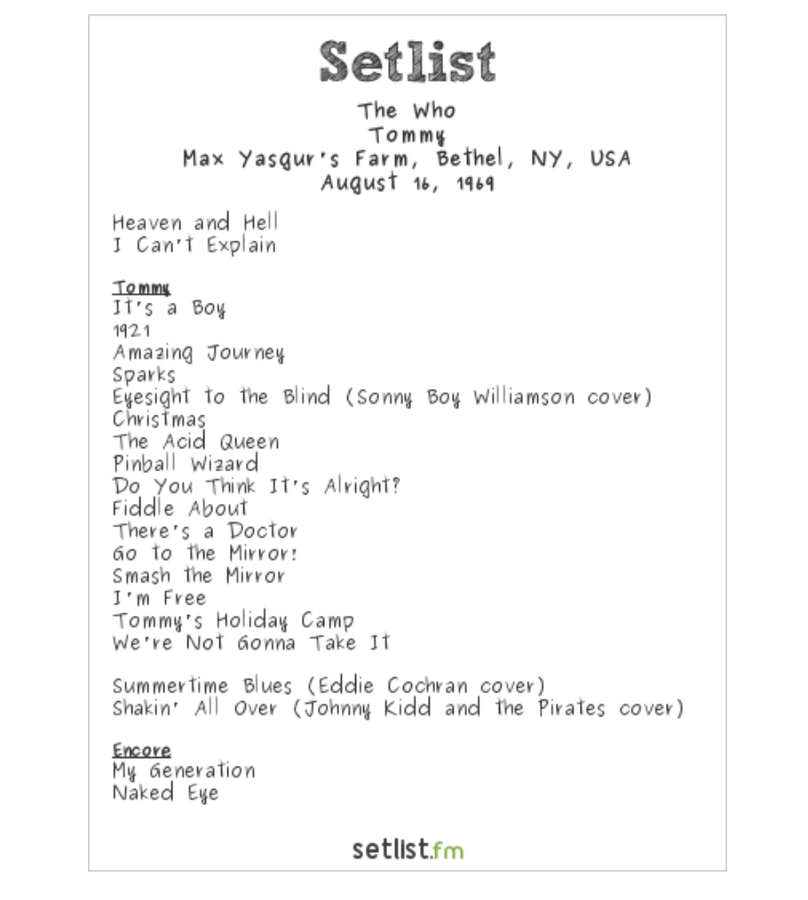
At Woodstock, the band played 15 tracks from the record in a bold statement that The Who would build a career of playing only by their own rules while raising the bar on what rock music and rock concerts could be.
Other tours during this decade: The Who Tour (1965–1966, 1967, 1968-69)
Albums released during this time: My Generation (1965), A Quick One (1966), The Who Sell Out (1967), Tommy (1969).
Fun fact: The prolific genius of Pete's songwriting and The Who as musicians led to over 100 million albums sold worldwide. Here is how their singles fared in the States.
“I Can’t Explain” (#93, 1965)
“Happy Jack” (#24, 1967)
“I Can See for Miles” (#9, 1967)
“Call Me Lightning” (#40, 1968)
“Magic Bus” (#25, 1968)
“Pinball Wizard” (#19, 1969)
“I’m Free” (#37, 1969)
“See Me, Feel Me” (#12, 1970)
“Summertime Blues” (#27, 1970)
“Won’t Get Fooled Again” (#15, 1971)
“Behind Blue Eyes” (#34, 1971)
“Join Together” (#17, 1972)
“Relay” (#39, 1972)
“Squeeze Box” (#16, 1976)
“Who Are You” (#14, 1978)
“Long Live Rock” (#54, 1979)
“You Better You Bet” (#18, 1981)
“Don’t Let Go the Coat” (#84, 1981)
“Athena” (#28, 1982)
“Eminence Front” (#68, 1982)
“It’s Hard” (#39, 1982)