Rise Against's frontman, Tim McIlrath, had so much to tell Bree on their most recent Marquee Memories chat, we couldn't resist having another post about the ways rock changed his life.
As you may recall, Tim grew up in the Northwest suburbs of Illinois about 45 minutes away from downtown Chicago and starting when he was a teen, he would venture into the city to catch shows.
In the last post he explained the lucky night he got to take in Nirvana at the beautiful Aragon Ballroom.
The very next year he also found himself at one of the most legendary punk shows in Chicago history, the night Fugazi and Shellac played at the now-leveled Rainbo Roller Rink.
"Fugazi was a band from Washington, D.C. They're my desert island band," Tim gushed.
"They're the band that I discovered earliest and stayed with me the longest probably, and I was very influenced by them, and not just who they are as a band but how they conducted what they do."
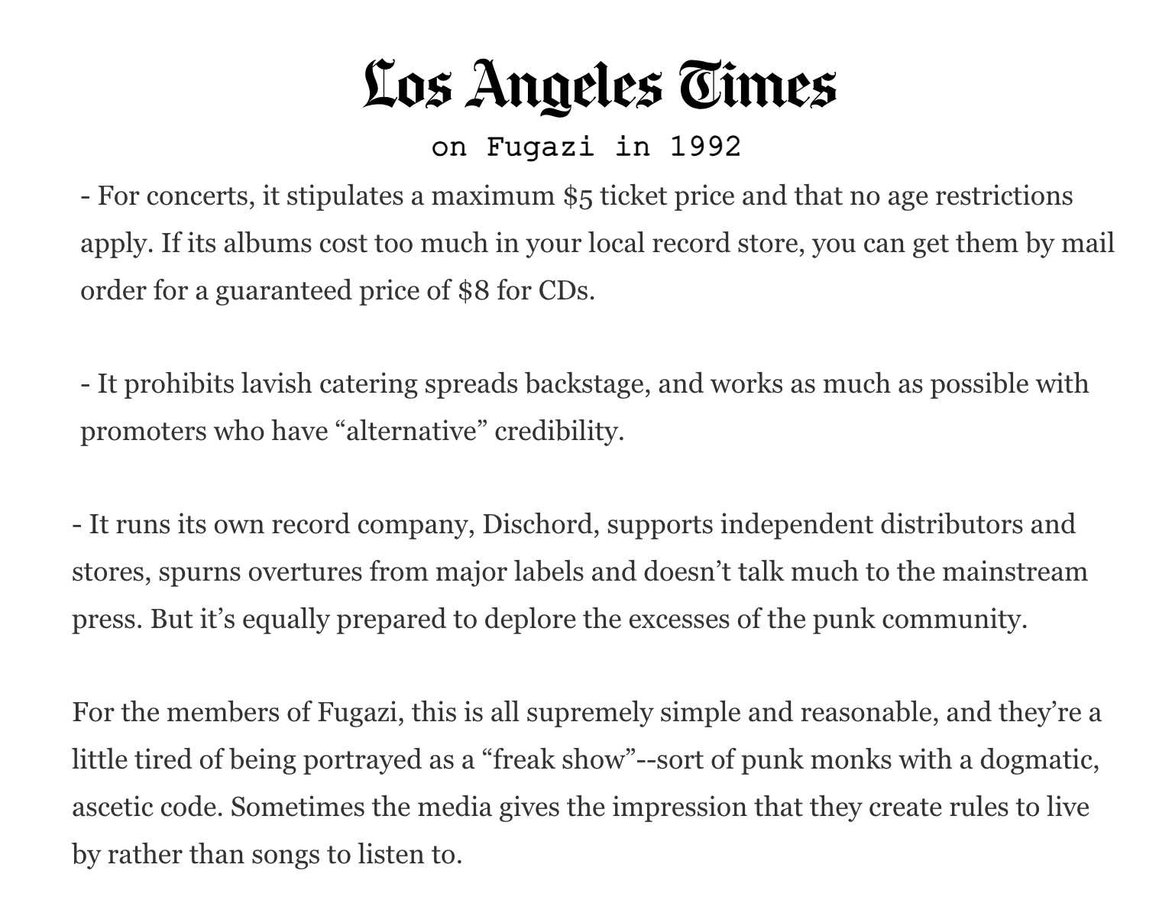
Fugazi singer/guitarist Guy Picciotto told Flipside in 1991, “our shows are all-ages, five dollars. That’s the deal. No barricades, no bouncers. Just people.”
That sort of idealism, originality, ethics and integrity rubbed off on Tim, and you don't have to look to hard to find that influence in Rise Against.
"People who know Fugazi know that they had a lot of rules about how they would treat this artistic endeavor, how they would release their own records, and how they would tour," Tom said.
"They wanted to tour outside of the normal venue system, the orthodox concert route that everyone takes. They wanted to take things like the bar and alcohol and divorce that from the show."
So it should have come as no surprise that when they got the opportunity to play at the Rainbo Roller Rink, just a few blocks away from traditional venues like the Aragon and the Riviera Theater, they went for it.
"I don't remember it being the best for sound, but it was definitely memorable, if not for any other reason than it was a band playing inside a roller rink, which was so bizarre," he recalled.
"I remember Shellac opened up, who were Chicago mainstays," he said of the post punk band fronted by the equally idealistic Steve Albini.
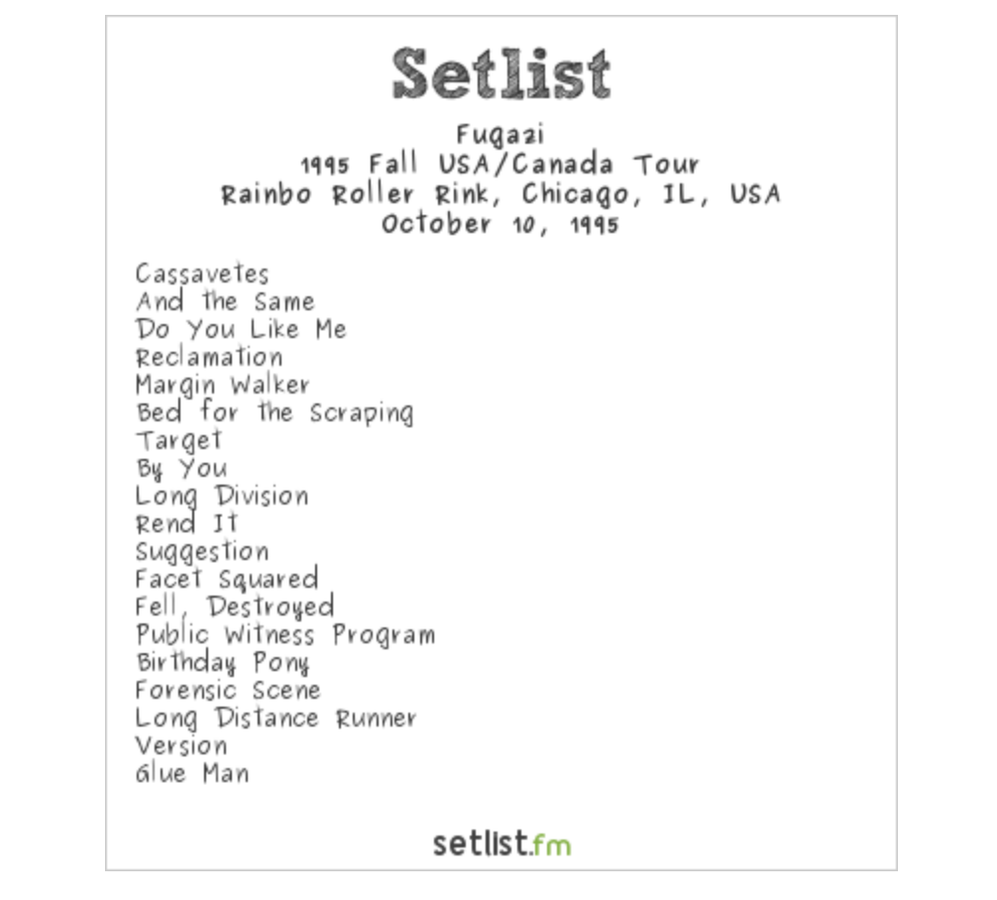
Fugazi immediately impressed 17-year-old McIlrath.
"Their music was like a weapon. It was very... animated and aggressive and inspiring, but also done in this really cool, artistic way," he explained.
"None of the songs sounded like each other. They were so intense on stage, and they didn't have set lists," he continued. "It's something that there never has been something like that before, and maybe there will never be something like that ever again. All that stuff blew me away. I was very inspired by all of it."
"I got to meet [Fugazi's] Ian MacKaye years later and mentioned that I was at that show," Tom continued.
"He said before the show, they were exploring the basement of the roller rink, because it was across the street from this gigantic cemetery, that's still there.
"He said that there were secret tunnels from under the roller rink into the cemetery, Prohibition-era tunnels that would then smuggle alcohol into the roller rink via this cemetery. They were down there looking for all these tunnels and that kind of thing," Tom said.
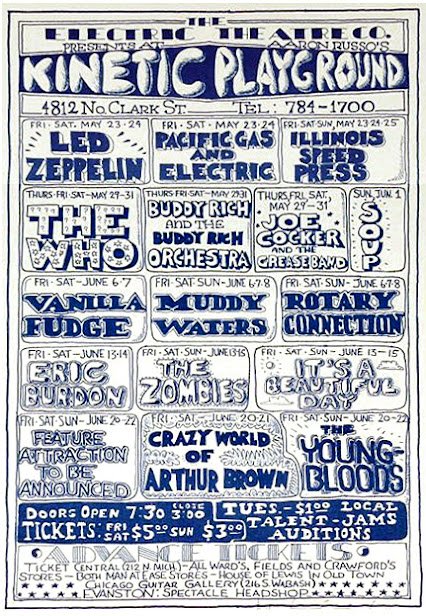
Before the Rainbo was a roller rink it had gone through many incarnations including a grand ballroom, an ice rink that the Chicago Blackhawks practiced on, and a rock club in the '60s that hosted Led Zeppelin and The Who.
"The roller rink is sadly not there anymore. I think it's a bunch of condos, but I think they're actually called the Rainbo-something condos or whatever, so that's a little nod to it," Tom told Bree.
"What I also liked about Fugazi ... and not even just Fugazi, but also Minor Threat and all the D.C. bands ... is that also I feel like they had no reverence for any fandom or worship culture," Tom explained.
"Here I'm talking about this band that I love... every bit of, but I also love them and know them enough to know that they would look at someone like me and go, 'Don't copy us. Do your own thing. Don't go down this exact road, and don't put us on a pedestal, because you can do this,'" he said.
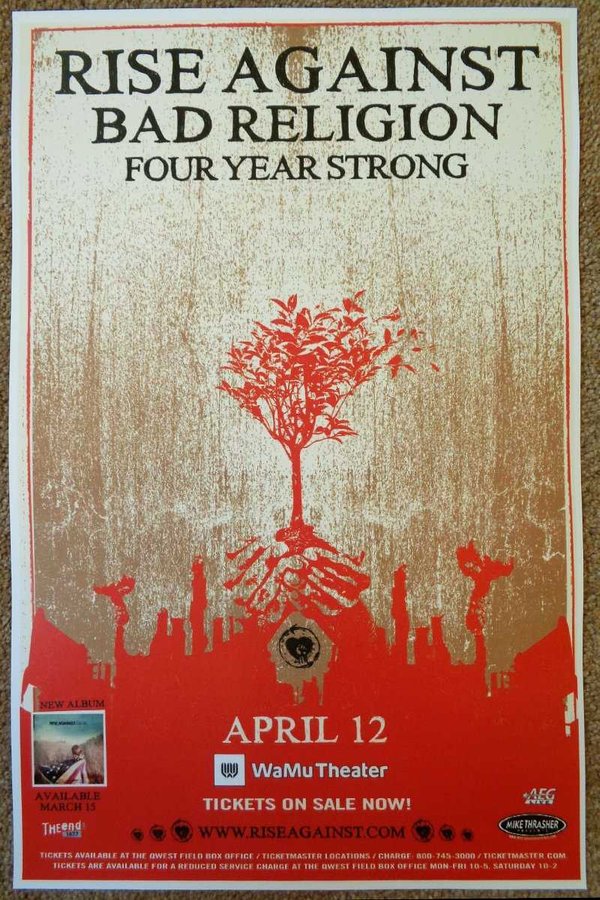
Because real life is stranger than fiction, Tom got to visit some holy punk rock ground thanks to opening for Bad Religion.
"Rise Against opened for Bad Religion early on in our career, probably like '04. Then maybe just like four years later, we had Bad Religion open for us, which was cool. They were really cool about it," Tom said of the equally independent band whose guitarist, Brett Gurewitz, founded Epitaph Records so they could release their own records without interference.
Over time Epitaph also put out records by Rancid, The Linda Lindas, NOFX, Pennywise, L7, Descendents, Motion City Soundtrack, Bring Me the Horizon, Parkway Drive, Alkaline Trio, Falling In Reverse, Social Distortion, Millencolin, The Distillers, Architects, and even Weezer.
"On that tour we rolled through Washington, D.C., and people might know that Brian Baker, the guitar player of Bad Religion, comes from the D.C. hardcore scene and played in Minor Threat. Minor Threat was Ian MacKaye's band before Fugazi," Tom said.
"We got to D.C. and Brian was like, 'Do you guys want to come to the Dischord House and meet Ian?'
"For any punk kid, this was like, I don't know, kind of a Mecca," he explained.
"We grew up seeing pictures of the Dischord House, and I grew up on Minor Threat records," he continued. "Minor Threat's a really important band to me. We jumped at the opportunity to crawl into Brian's Subaru."
As influential as Minor Threat were, they were only around for just three years (1980 to 1983). They released two EPs in 1981 (Minor Threat and In My Eyes), followed by the Out of Step LP in 1983. Their final release, Salad Days, came out posthumously in 1985 but was recorded in 1983.
"It was really cool. I remember he was standing on the front porch when we pulled up, and I don't think [Ian] was that familiar with our band, but he must have done a quick Google search or something like that," Tom said.
"And the first thing he pulled up was a video that we had made [for 'Re-Education (Through Labor)]] of a moped army in Chicago walking around, blowing up buildings, like a Fight Club style thing. So it was a pretty crazy video.
"And he had just watched that when we walked up. And so he's like, 'You guys are Rise Against?'
"And we're like, 'Hey.'
"He's like, 'Whoa, you guys are like, he's pointing to the laptop like, 'You're hardcore.' "We're like, 'Wait, what? Did he just call...' Yeah, 'Hold on. Can you say that again? Can you say it a little louder, into the mic?'
"And anyway, he gave us a great tour of the building, which is a really cool archive of everything Dischord has done," Tom said.
"And that might be the coolest thing that ever came out of doing this band... that's the thing I want to go back in time and tell the 15-year-old me like, 'Yo, this guy knows your name," he said, proudly.
Rise Against is touring through Europe and then will be rocking North America at the end of the month.
Cross your fingers that they'll play a tune or two from their forthcoming album, Ricochet, due in August. Tickets available on their website.